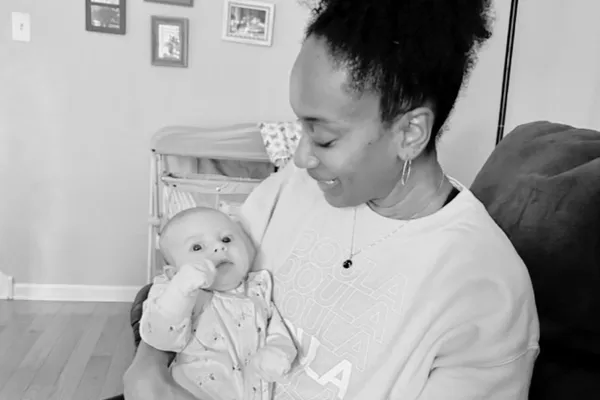
Building your birth and postpartum team that includes a doula
As a professional, you don't bring someone onto your team without a real conversation about who they are as a person, how they work, and how they react when things go sideways. You ask follow-up questions. You check references.
Then you get pregnant or you have a baby, and somehow the team that matters most, the people who will support you during one of the biggest transitions of your life, gets assembled by default. Whoever your insurance assigned. Whoever's on call. Whoever seemed fine in one fifteen-minute intake appointment.
Healthcare systems are designed for access and efficiency, not for deeply personalized team-building, which is why so many families default to whoever is available instead of intentionally choosing who supports them. That gap between how carefully you build every other team in your life and how passively you build this one is worth closing, and now there's more support for closing it than there was.
The American College of Obstetricians and Gynecologists (ACOG) released its first committee statement telling ob-gyns to actively partner with doulas as part of the care team (ACOG, 2026a, 2026b). This guidance is not based on new evidence that has existed for over a decade. What's new is that the field's largest professional body just said out loud what a lot of people already suspected: it’s not a nice-to-have add-on to your birth and parenting plan. It's a team decision, and ob-gyns are now being told to treat it that way. In practice, this means encouraging collaboration, clear communication, and mutual respect for each role’s scope within the pregnancy care team.
For you, this shifts the conversation from optional support to an expected part of a well-structured care team. That matters less for what it changes in any one hospital or practice tomorrow and more for what it gives you. Language. Legitimacy. A reason your ob-gyn and care team should already be receptive to the conversation.
A doula provides continuous physical, emotional, and informational support during labor. They do not perform clinical tasks like diagnosing, exams, monitoring, and they don’t make decisions on your behalf. Instead, they support comfort through positioning, breathing, and physical techniques, help you process information in real time, and reinforce your preferences so you can participate actively in decision-making (DONA International, 2022a; DONA International, n.d.a).
Your ob-gyn or midwife is focused on your clinical care. Your nurse is caring for other patients at the same time. Your partner is holding their own fear while trying to hold yours. A doula's entire focus is you. They are not a replacement for medical care, but a complementary role focused entirely on continuous support that the clinical team is not structured to provide.
A doula’s job also doesn't end when the baby arrives. Full-spectrum support includes prenatal preparation, continuous presence through labor, and structured help in the weeks after birth, when most families are quietly drowning and nobody's checking in anymore. Postpartum doulas provide structured, non-clinical support that may include newborn care education, feeding guidance, emotional support, and helping families establish rhythms around sleep, recovery, and daily care (DONA International, 2022b). This layer of support is especially critical as clinical care typically decreases after discharge, leaving families to navigate recovery and infant care with minimal oversight.
You can engage a birth doula and postpartum doula as one continuous relationship, or as two separate, deliberate decisions, since the two roles are distinct: one focused on labor and delivery, the other on recovery and early parenting adjustment. Deciding what level of postpartum support you want in advance prevents gaps in care during one of the most vulnerable transitions.
The pregnant family, care team, and the doula are not competing roles. The doula is part of the care, where each role fills a gap the others are not structured to cover. This coordinated approach works best when expectations and communication preferences are discussed in advance, so everyone understands how to support you under changing conditions.
A Cochrane review combining more than 15,000 births found doula-supported labor came with 28 percent fewer cesareans, 31 percent less use of synthetic oxytocin, and 34 percent fewer people rating their birth experience negatively, compared to usual care (Bohren et al., 2017). These outcomes reflect not just comfort, but measurable differences in intervention rates and overall birth experience. Doulas also play a measurable role in whether patients feel heard and respected during labor, particularly when navigating a hierarchical medical system under pressure (Dekker et al., 2024).
You know how to read a room and push back when something's off. You've done it in negotiations, in performance reviews, in rooms where you were the only person who saw the problem before it became one. But pregnancy, labor, birth and parenting ask you to do that same thing while running on no sleep, adrenaline, and a nervous system doing something it has never done before. You’re operating on a different environment than any job you've ever walked into. A doula helps bridge that gap by supporting real-time communication, reinforcing your preferences, and helping you stay oriented in moments where decisions may feel rushed or unclear.
This is exactly why you need to decide your advocacy preferences in advance. What do you want said if you're not being heard? The same delegation instinct you use at work can be applied when working with a doula. This is also why strategic preparation beats a birth plan alone. A plan assumes everything goes as scripted. Strategic preparation, on the other hand, includes defining your communication preferences, identifying decision-making boundaries, and aligning your support team ahead of time.
As more families approach doula support as part of their care plan, access and coverage are beginning to shift as well. Doula coverage is also expanding nationwide in the United States. Some employer-sponsored plans now include doula support through reimbursement models or partnerships with maternity care platforms, making access more feasible for working families (UnitedHealthcare, 2026). At the same time, Medicaid expansion across multiple states has increased access, although variability in reimbursement rates and provider participation continues to affect availability (Peters & Robles-Fradet, 2025). Checking your specific benefits early in pregnancy gives you more options and time to secure a provider who aligns with your needs.
Whether you're vetting a birth doula, a postpartum doula, or both, you already know how to evaluate whether someone earns a seat on your team. Use that same discipline here. When choosing a doula, consider their training and certification, experience with different birth settings, communication style, availability during your due window, and how they approach situations that deviate from plan (DONA International, n.d.b).
Alignment in both philosophy and practical logistics is what turns support into an actual asset during labor and postpartum. Many families begin this process later than they intend and find that preferred doulas are already booked, especially in high-demand areas. Download this FREE Provider Evaluation Checklist to evaluate any member of your care team before you commit.
I'm also a DONA-certified birth and postpartum doula, and created The S.M.A.R.T. Journey to Parenting® after three very different births of my own while running global teams in a demanding 20+ year pharmaceutical career. I've been the exhausted client at 2 a.m. and the doula answering that call. Both experiences taught me the same thing: nobody plans this transition with the rigor they'd apply anywhere else in their life. Explore what my doula and perinatal coaching support looks like here.
Dr. Michelle El Khoury is the founder of Yogamazia® and creator of The S.M.A.R.T. Journey to Parenting®. She offers yoga, mindfulness, and doula support for women, families and organizations navigating every season of change. Learn more at yogamazia.com.
References
American College of Obstetricians and Gynecologists. (2026a, July 16). ACOG releases new guidance for ob-gyns on partnering with doulas [Press release]. https://www.acog.org/news/news-releases/2026/07/new-guidance-for-ob-gyns-on-partnering-with-doulas
American College of Obstetricians and Gynecologists. (2026b). Partnering with doulas in clinical settings (ACOG Committee Statement No. 31). Obstetrics & Gynecology, 148(2), e139–e149. https://www.acog.org/-/media/project/acog/acogorg/clinical/files/committee-statement/articles/2026/08/partnering-with-doulas-in-clinical-settings.pdf
Bohren MA, Hofmeyr GJ, Sakala C, et al. Continuous support for women during childbirth. Cochrane Database of Systematic Reviews 2017, Issue 7. Art. No.: CD003766. DOI: 10.1002/14651858.CD003766.pub6. https://www.cochranelibrary.com/cdsr/doi/10.1002/14651858.CD003766.pub6/full
Dekker R, Ailshire S, & Ali I. (2024). Evidence on: Doulas [Signature article]. Evidence Based Birth. https://evidencebasedbirth.com/doulas
DONA International. (n.d.a).Benefits of a doula. https://dona.org/benefits-of-a-doula
DONA International. (n.d.b). How to hire a doula. https://dona.org/how-to-hire-a-doula
DONA International. (2022a). Position paper: The birth doula's role in perinatal care. https://dona.org/resource/birth-doula-position-paper
DONA International. (2022b). Position Paper: The Postpartum Doula’s Role in Perinatal Care. https://dona.org/wp-content/uploads/2026/04/DONA-Postpartum-Position-Paper-2022.pdf
Peters R & Robles-Fradet A. (2025, January 23). 2024 update: Medicaid coverage for doula care requires sustainable and equitable reimbursement to be successful. https://healthlaw.org/2024-update-medicaid-coverage-for-doula-care-requires-sustainable-and-equitable-reimbursement-to-be-successful
UnitedHealthcare. (2026, January 2). UnitedHealthcare launching Doula Support effective January 1, 2026. https://www.uhc.com/agents-brokers/employer-sponsored-plans/news-strategies/doula-support-benefit-launching-jan-1
