
Being Told You Need a Labor Induction? Read This First
More and more, in my work as a doula, I’m seeing families be told around 39 weeks that induction is the next step, often after otherwise uncomplicated pregnancies.
Now, don’t get me wrong, labor induction is medically necessary in some cases. But for many, the recommendation can arrive suddenly, as if the decision has already been made for them. That is exactly why it matters to understand what induction involves, when it is truly indicated, and which questions help you make an informed choice, which is why this blog is a longer than usual read.
What is a labor induction?
A labor induction is the use of medication or other methods to start labor before it begins on its own [1]. It is common, and often appropriate. In the United States, labor induction increased from 24.9% in 2016 to 34.5% in 2024 [2].
Pregnant families should be allowed to understand what is being offered, ask what the evidence is for their situation, and take the time to decide from clarity rather than fear. This blog outlines what an induction involves, why the timing matters more than most people are told, and a set of questions built on the BRAINS framework to help you evaluate any recommendation.
An induction is not one procedure but a series of steps, and each one has its own benefits, risks, and alternatives you are entitled to understand before it happens.
The method often depends on how ready your cervix already is, which is usually assessed with a Bishop score, a clinical tool that estimates cervical readiness based on dilation, effacement, station, consistency, and position [3].
If the cervix is not yet favorable, often defined as a Bishop score of 6 or less, induction usually begins with cervical ripening using medication or a balloon catheter to help the cervix soften and open. Once the cervix is more ready, labor may be stimulated with synthetic oxytocin or by breaking the amniotic sac.
Knowing the induction sequence in advance is the difference between being moved through a process and moving through it with intention.
Your due date is a range, not a deadline
Only a small percentage of babies are born on their exact due date, and the 40-week estimate is just that. The due date is useful for planning, but it does not predict the exact day labor will begin [4].
Most pregnancies do not end at exactly 40 weeks. Many first-time birthing people do not go into labor by the exact due date, which is one reason the due date should be treated as a planning tool rather than a hard stop. A due date of 40 weeks does not mean labor will begin by that day, and being a few days past it is common rather than concerning.
Understanding that your due date is a window changes the questions you ask. When you know the calendar is an estimate, "you are past your date" becomes something to explore rather than a reason to rush. That single reframe helps you ask for the evidence behind a recommendation instead of accepting timing as a given.
39 weeks vs 41 weeks
The timing of an induction recommendation also matters as the evidence for induction is not the same at every week, and that difference matters enormously. This is where many families are given a blurred picture, so it is worth separating clearly.
At 39 weeks, in a low-risk singleton first pregnancy, induction is generally considered elective rather than medically required [5]. In the ARRIVE trial, planned induction at 39 weeks did not improve the primary neonatal composite outcome, but it was associated with a lower cesarean rate in low-risk first-time pregnancies, about 18.6% versus 22.2% [6]. The American College of Obstetricians and Gynecologists (ACOG) also says it’s reasonable to offer elective induction at 39 weeks to low-risk, first-time patients, and that decision should be made through shared decision-making that takes the patient’s values, preferences, and local resources into account [1].
At 41 weeks and beyond, the evidence shifts. Induction at 41 weeks has strong evidence for reducing stillbirth and early newborn death compared with continuing pregnancy to 42 weeks [7,8]. The overall risk of stillbirth rises gradually after 39 weeks and then more sharply from 41 weeks.
So "induction at 39 weeks" and "induction at 41 weeks" are two different conversations with two different evidence bases that can tell you how much room you have to weigh the choice.
What safe waiting looks like
If you and your provider decide that waiting is a reasonable option for your situation, waiting does not mean doing nothing. It means continuing the pregnancy with regular monitoring so that you and your care team can watch how your baby is doing while labor has the chance to begin on its own.
The tools for this are worth knowing by name, so you can ask about them. Kick counts track your baby's movement patterns, and are something you can do yourself at home. A non-stress test (NST) checks your baby's heart rate over time. A biophysical profile (BPP) combines an ultrasound look at movement, tone, breathing, and fluid. And a fluid check measures the amount of amniotic fluid around your baby. Together these are how a care team keeps a close eye on a pregnancy that continues past the due date.
This matters because monitoring changes the picture. If you choose expectant management, the conversation should include what monitoring will be used, how often it will happen, and what findings would change the plan [9]. So the real question is rarely "induce now or do nothing". It is more often "induce now, or wait with a clear monitoring plan".
If waiting is on the table, ask what monitoring would look like. How often would you be checked, with which tests, and at what point the recommendation would change. A waiting plan with clear monitoring is a decision. Waiting with no plan is not.
When induction has a clearer medical basis, and when it is more nuanced
Not all reasons for induction carry the same weight of evidence, so one of the most important questions is: What is the specific indication in my case? [7]. Some situations have a clearer medical basis; others rest more on expert opinion than on strong research.
Table 1 provides a general summary of the evidence for several commonly cited reasons. Note, it is not intended as guidance for your specific pregnancy — always discuss your situation with your provider.
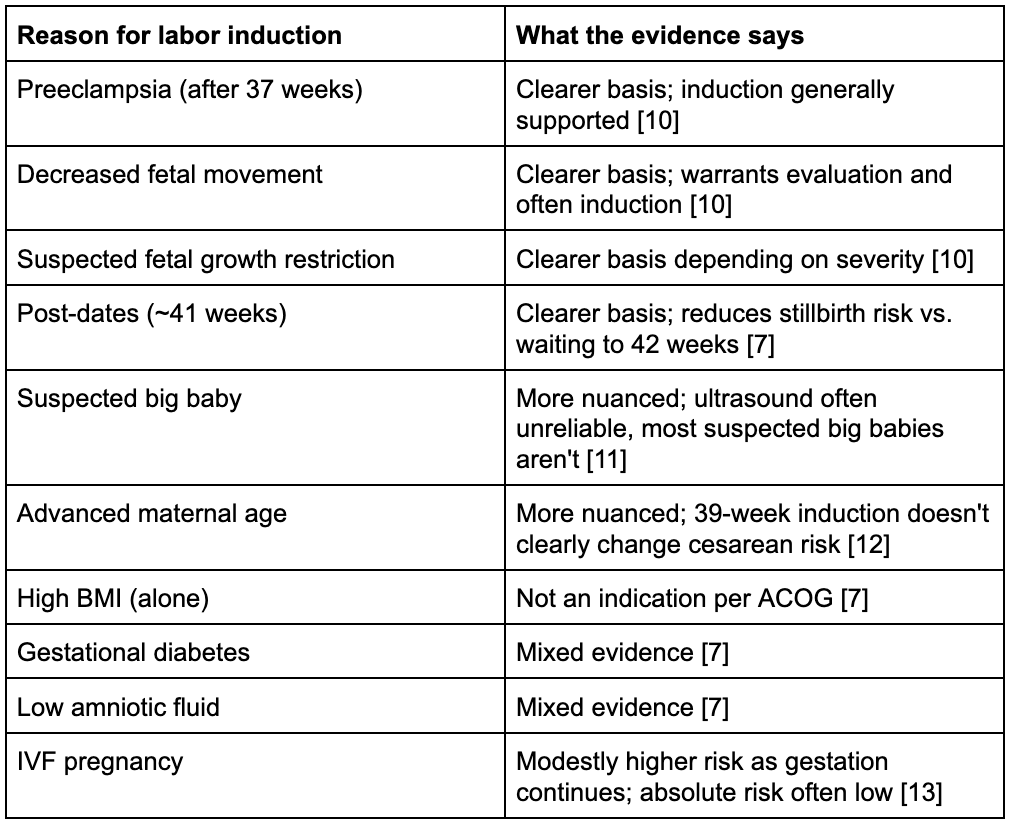
Any risk factor should open a conversation about your specific numbers. When you know whether your reason sits in the clearer or the more nuanced category, you know how many questions to ask.
Why knowing the questions is not enough
You can hold every fact about induction and still freeze in the room. Your ability to advocate depends less on what you know and more on whether you are calm enough to reach it.
When a recommendation lands as urgent and unexpected, your body can read the moment as a threat. In that state, your thinking narrows and the questions you prepared disappear. Returning to calm first, through a few slow breaths with a longer exhale, is what makes clear thinking available again.
Advocacy is not a personality trait. It is a state you can return to on purpose. This is why I work on staying grounded with clients long before any decision arrives, and why emotional regulation matters in pregnancy. Learning to return to calm under pressure is the foundation every other skill is built on.
Prepare to use your BRAINS
BRAINS is a decision-making tool that helps you slow down a recommendation and walk through six angles: Benefits, Risks, Alternatives, Intuition, Nothing, and Space. It gives you a structure to lean on when the moment feels fast and the pressure feels high.
Benefits. Ask what specifically induction is meant to achieve for your pregnancy. What outcome are we trying to protect, and what does the evidence show for my situation?
Risks. Every option carries risk, including both inducing and waiting, so ask for both sides. What are the risks of inducing now, and what are the risks of waiting with monitoring?
Alternatives. Ask whether there is a middle path, such as expectant management, which means continuing the pregnancy with closer monitoring rather than inducing today.
Intuition. Your own read on the situation is information. Does the urgency match what you are experiencing, or does something feel off?
Nothing. Ask what happens if you do nothing. Is this a genuine emergency, or a recommendation you have time to consider?
Space. Unless it is a genuine emergency, you can ask for time. Can I take a few hours, or a day, to think this through and talk with my partner?
Informed consent means a recommendation is explained clearly enough that you can understand it, weigh it, and decide from a place of confidence rather than fear [1]. It is a process you participate in, not a form you sign at the end.
Fear-based framing can run in either direction, both toward induction and against it, so the skill is recognizing pressure itself rather than taking a side. A recommendation delivered without a real conversation is the pattern worth questioning, never the individual clinician making it. The system around them, with its time pressure and defaults, is often what compresses the conversation.
Asking for the evidence, and for time to think, is a reasonable and expected part of nurturing mental wellness for expecting parents and staying mentally grounded through big decisions.
Making a decision that aligns with your birth vision
Induction can be the right choice, the wrong choice, or simply a choice you need more information to make. What matters most is that the decision belongs to you, and that you have the knowledge and calm to make it from a place of clarity rather than fear.
Underneath every question you have is a quieter one: Does this align with the birth I already pictured for myself? When you have named how you want to feel walking into your pregnancy journey, and what matters most to you, each recommendation has something to measure against.
If you want extra support preparing for those conversations, I created a resource: Prepared Pregnancy: Calming 5 Common Fears for a Confident Birth, to help you name your fears, ask better questions, and step into birth with more confidence.
Dr. Michelle El Khoury is the founder of Yogamazia and creator of The S.M.A.R.T. Journey to Parenting®. She offers yoga, mindfulness, and doula support for women, families and organizations navigating every season of change. Learn more at yogamazia.com.
References
American College of Obstetricians and Gynecologists. (2024). Induction of labor at 39 weeks (FAQ507). Available from https://www.acog.org/womens-health/faqs/induction-of-labor-at-39-weeks
Martin JA, Osterman MJK. (2026). Induction of Labor Increases in the United States: 2016 to 2024. In: NCHS Data Briefs [Internet]. Hyattsville (MD): National Center for Health Statistics (US); 2024 Jul. No. 554. Available from: https://www.ncbi.nlm.nih.gov/books/NBK621496
Wormer KC, Bauer A, Williford AE. (2024). Bishop Score. In: StatPearls [Internet]. Treasure Island (FL): StatPearls Publishing. Available from: https://www.ncbi.nlm.nih.gov/books/NBK470368
Dekker R & Ailshire S. (2026). Evidence on: What is a Due Date? Available from https://evidencebasedbirth.com/evidence-on-due-dates
Oklahoma Perinatal Quality Improvement Collaborative. (2018). ACOG Practice Advisory/SMFM Clinical Statement: Clinical guidance for integration of the findings of The ARRIVE Trial: Labor Induction versus Expectant Management in Low-Risk Nulliparous Women. Available from https://opqic.org/acog-practice-advisory-smfm-clinical-statement-clinical-guidance-for-integration-of-the-findings-of-the-arrive-trial-labor-induction-versus-expectant-management-in-low-risk-nulliparous-women/
Nethery E, Levy B, McLean K, et al. (2023). Effects of the ARRIVE (A Randomized Trial of Induction Versus Expectant Management) Trial on Elective Induction and Obstetric Outcomes in Term Nulliparous Patients. Obstet Gynecol, 142(2):242-250.
American College of Obstetricians and Gynecologists. (2021). Medically Indicated Late-Preterm and Early-Term Deliveries Committee Opinion No. 831. Available from https://www.acog.org/clinical/clinical-guidance/committee-opinion/articles/2021/07/medically-indicated-late-preterm-and-early-term-deliveries
Rosenstein MG, Cheng YW, Snowden JM, et al. (2012). Risk of stillbirth and infant death stratified by gestational age. Obstet Gynecol, 120(1):76-82. doi: 10.1097/AOG.0b013e31825bd286.
American College of Obstetricians and Gynecologists. (2025).ACOG Explains: Inducing Labor. Available from https://www.acog.org/womens-health/videos/inducing-labor
American College of Obstetricians and Gynecologists. (2025). Preeclampsia and High Blood Pressure During Pregnancy (FAQ034). Available from https://www.acog.org/womens-health/faqs/preeclampsia-and-high-blood-pressure-during-pregnancy
Dekker R. (2021). Evidence on: Induction or Cesarean for a Big Baby. Available from https://evidencebasedbirth.com/evidence-for-induction-or-c-section-for-big-baby/
Dekker R, Bertone A & Breakey A. (2021). Evidence on: Pregnancy at age 35 and older. Available from https://evidencebasedbirth.com/advanced-maternal-age/
Society for Maternal-Fetal Medicine, Ghidini A, Gandhi M, et al. (2022). Management of pregnancies resulting from in vitro fertilization (Consult Series No. 60). Available from https://publications.smfm.org/publications/435-society-for-maternal-fetal-medicine-consult-series-60/
